Government & Institutional Office Clearance – Special Requirements
The definitive compliance framework for regulatory asset auditing, certified data sanitization, and green institutional decommissioning.
Navigating a Government & Institutional Office Clearance – Special Requirements checklist demands flawless adherence to security, procurement, and environmental protocols. When public sectors or state academies modernize facilities, redundant property disposal requires a highly programmatic approach. Executing verified workflows guarantees that public administrations eliminate informational security gaps, meet state financial rules, and protect tax-funded assets from non-compliant scrap pipelines.
AI Overview & Quick Answer
What are the special requirements for government office clearance? Government office clearance requires total transparency, tender compliance under General Financial Rules (GFR), explicit asset scrap auditing, and certified secure data destruction following NIST SP 800-88 guidelines. Furthermore, all electronic discards must be cleared via pollution board authorized channels with complete multi-tier paperwork matching state audit trails.
Improvising asset clearance operations can result in strict legal citations, data privacy leaks, and loss of public funding confidence. To secure complex projects, civic facility managers source premium Government Office Clearance Services. Securing an established, end-to-end provider for your comprehensive Institutional Office Clearance needs keeps localized department moves, university overhauls, or healthcare clear-outs insulated from regulatory compliance faults.
Key Takeaways
- Public sector clear-outs must closely align with General Financial Rules (GFR) asset scrap criteria.
- Certified data sanitization provides verified security layers before tech units exit state custody.
- Enforcing rigorous source-based segregation separates hazardous elements from standard wood or metal furniture.
- Comprehensive audit trail reports protect administrative departments from statutory compliance failures.
What This Guide Covers
- Regulatory Foundations of Government & Institutional Office Clearance – Special Requirements
- Value Optimization: Compliant Office Clearance Services and Asset Valuations
- The Step-by-Step Government Office Dismantling & Decommissioning Process
- Data Defenses: Secure Institutional Data Destruction and Storage Isolation
- Environmental Responsibility: Institutional Office Equipment Recycling and Rules
- Comprehensive Audit Trail and Institutional Asset Clearance Checklist
- Frequently Asked Questions (FAQ)
Managing public infrastructure demands unmatched tracking precision and complete operational openness. At Urban Eco Recyclers, we eliminate compliance concerns across Bengaluru—delivering physical room surveying, color-coded material container drops, certified file and hardware shredding, and authorized state clearance logging so your administrative specialists stay focused on critical public workflows and public service mandates.
Regulatory Foundations of Government & Institutional Office Clearance – Special Requirements
Civic departments and public infrastructure lines work inside a distinct operational framework. When clearing obsolete data labs, university floors, or municipal buildings, simple material relocation is insufficient. Satisfying the official Government & Institutional Office Clearance – Special Requirements manual calls for highly structured tracking setups to document asset changes from public ledgers completely.
A smart state transition treats scrap management as a core legal process. Organizing bulk Government Office Clearance Services demands close coordination between logistics staff and procurement managers. This deliberate structure ensures that large-scale furniture sorting, structural space clearing, and building handbacks execute predictably without introducing liability concerns to the department budget.

Value Optimization: Compliant Office Clearance Services and Asset Valuations
Administrative layout modernizations must show absolute fiscal accountability. By leveraging vetted Compliant Office Clearance Services, public organizations ensure that surplus furniture, metal cabinet frameworks, and modular partitions are evaluated with complete transparency. This prevents undervalued scrap assignments, helping department heads defend ledger offsets to state financial oversight teams.
A meticulous Institutional Office Clearance plan records physical asset weights and operational conditions before items enter transport lines. This thorough auditing approach protects tight infrastructure budgets, shifting old materials into reliable secondary processing cycles while generating verified disposal receipts for public financial reviews.
| Institutional Asset Group | Primary Compliance Target | Authorized Handling Action | Audit Trail Requirement |
|---|---|---|---|
| Confidential IT Hardware | NIST SP 800-88 Data Sanitization | Software wipe / On-site drive shredding | Serialized Destruction Certificate |
| Department E-Waste | KSPCB / CPCB authorized collection | Certified material extraction handling | Form 6 Hazardous Manifest Receipt |
| Administrative Furniture | GFR inventory removal verification | Modular workstation dismantling loop | Commercial weight bridge ledger item |
| Archived Paper Records | ISO 27001 Information Privacy | Bulk high-security industrial shredding | Certified pulping recycling clearance |
The Step-by-Step Government Office Dismantling & Decommissioning Process
Achieving total operational transparency across complex civic networks requires following a rigid sequence during a strategic Government & Institutional Office Clearance – Special Requirements project:
- Official Ledger Reconciliation: Cross-reference every active desk unit, server panel, and storage cabinet with state registry documents to verify disposal permissions.
- Vetted Security Clearance: Complete background checks and obtain explicit entry permits for all contractor handling crews before on-site work begins.
- Secure Data Eradication: Run certified data wipes or physical mechanical shredding on all local network storage components inside secure departmental boundaries.
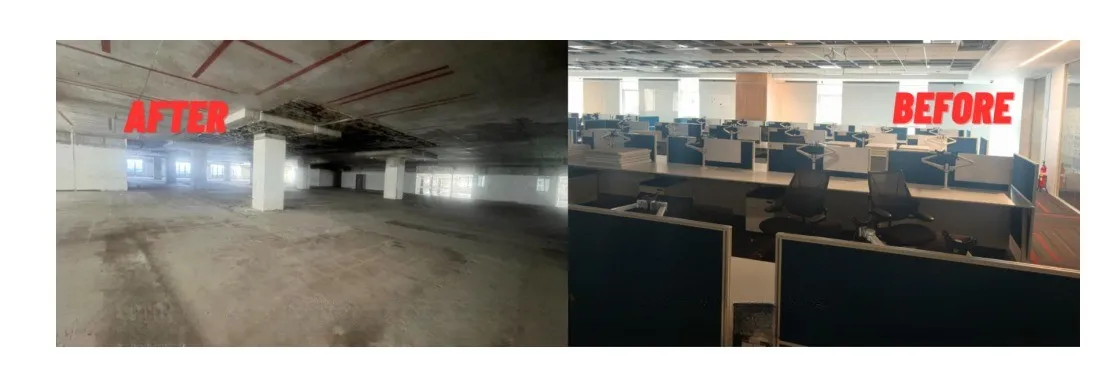
- Surgical Government Office Dismantling: Take down heavy modular wall panels, false ceiling grids, and copper data bundles systematically to preserve material sorting lines.
- Manifest-Tracked Haulage: Secure materials in vehicles tracked with real-time GPS monitoring, delivering cargo directly to state-approved reclamation centers.
Data Defenses: Secure Institutional Data Destruction and Storage Isolation
Decommissioning public facilities exposes tracking networks to severe information vulnerability. Old local workstation arrays, mainframe systems, and citizen-record databases hold highly sensitive demographic data that cannot be compromised. Protecting these assets requires following strict information security guidelines as part of your comprehensive Government & Institutional Office Clearance – Special Requirements project plan.
Mixing institutional data storage blocks with general commercial scrap creates serious vulnerabilities. Safe department transitions demand data erasure workflows that match rigorous ISO 27001 and NIST SP 800-88 Rev. 1 criteria, using multi-pass software overwriting software or industrial on-site disk crushing.
Partnering with an experienced, high-tier technical team keeps your digital archives secure. Every step must produce unalterable, serialized destruction records, safeguarding your administration from data discovery incidents and providing your compliance leads with perfect audit-trail documentation.
Environmental Responsibility: Institutional Office Equipment Recycling and Rules
Fulfilling modern corporate governance benchmarks calls for advanced handling of retired equipment. In major technology zones and municipal clusters, throwing old electronic systems into mixed urban dumping containers is strictly illegal.
All institutional electronic waste pipelines must directly comply with national Extended Producer Responsibility (EPR) regulations and state pollution control board rules. Working with an authorized, KSPCB-compliant recycler ensures that heavy metals and trace elements are extracted safely, turning outdated electronics back into pure industrial resources and supporting green, zero-landfill public development goals.
Comprehensive Audit Trail and Institutional Asset Clearance Checklist
Follow this master checklist during project initialization to maintain flawless alignment with updated Government & Institutional Office Clearance – Special Requirements directives:
- Reconcile physical equipment tags directly with active government asset accounting ledgers.
- Obtain verified on-site background security clearances for all logistics and un-installation staff.
- Verify your clearance vendor holds active KSPCB pollution control permits and GFR tender compliance.
- Complete NIST-compliant data destruction on all storage devices before they leave secure department gates.
- Separate processing streams into distinct containers for dry recyclables, e-waste, and general wood items.
- Secure formalized Form 6 hazardous waste manifests and green recycling receipts for permanent office compliance records.
Secure Your Institutional Compliance Metrics
Urban Eco Recyclers provides fully compliant un-installation services, high-security data destruction, and certified eco-friendly recycling that meets strict public sector tender criteria.
📞 Consult with Our Public Sector Liaison 💬 Request a Compliant Site Survey & QuoteStrategic Workspace Decommissioning Insights
Frequently Asked Questions (FAQ)
What are the special requirements for government office clearance?
How do government departments safely manage data privacy during large facility moves?
Can public universities and schools claim formal recycling credits for outdated computers?
Why is source-based segregation mandatory for institutional decommissioning sites?
What core documentation must an authorized clearance provider deliver for internal audits?
Contact Urban Eco Recyclers
Address: Site No. 8K, No. 1092/8/78/79, Ground Floor, 1st 'B' Main Road, A&T Junction, Janatha Colony, Dodda Kannelli, Varthur Hobli, Bengaluru – 560036
Phone:+91 91872 40457 | +91 70190 56140
Email:ewastescrap.blr@gmail.com
Hours:Monday – Saturday, 9:00 AM – 6:00 PM
© Urban Eco Recyclers, Bengaluru · Government Logistics · Compliant Dismantling · Authorized Institutional Asset Recycling